Paranoid Circle (2025 – )
Drawing with tank tracks on matt-white painted steel
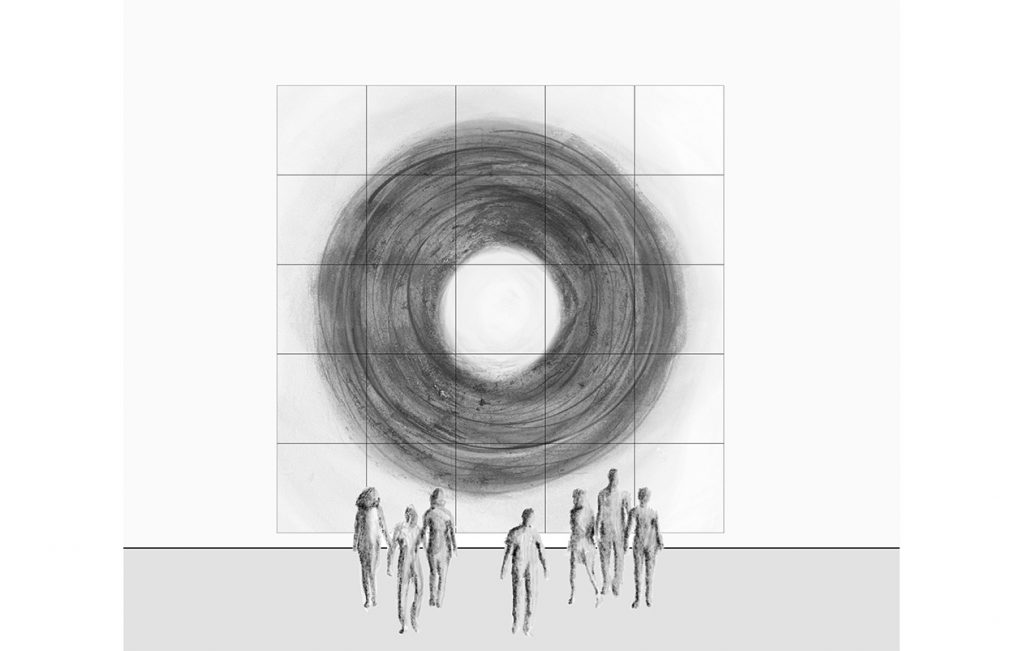
650 × 650 × 0.4 cm
Paranoid Circle was initially thought for the exhibition Ratatataa at the Kunstmuseum Karlsruhe, though it was never realized.
The Kunstmuseum Karlsruhe’s building, formerly a weapons and ammunition factory, is now a museum and exhibition space with an extensive collection. Considering its previous use, the space has undergone a significant transformation—shifting from weaponry to art, from the rapid shipping of items to the storage of a collection, and from the mass production of single items to the diversity of artworks.
This transformation prompted us to ask the following questions: What if this museum went back to the late 1930s and experienced its own space as a weapons and ammunition factory? Or, if this space—once a weapons and ammunition factory—came to the present day and saw itself as an art museum, how would these two states conceptually merge? What kind of art project might emerge from this?
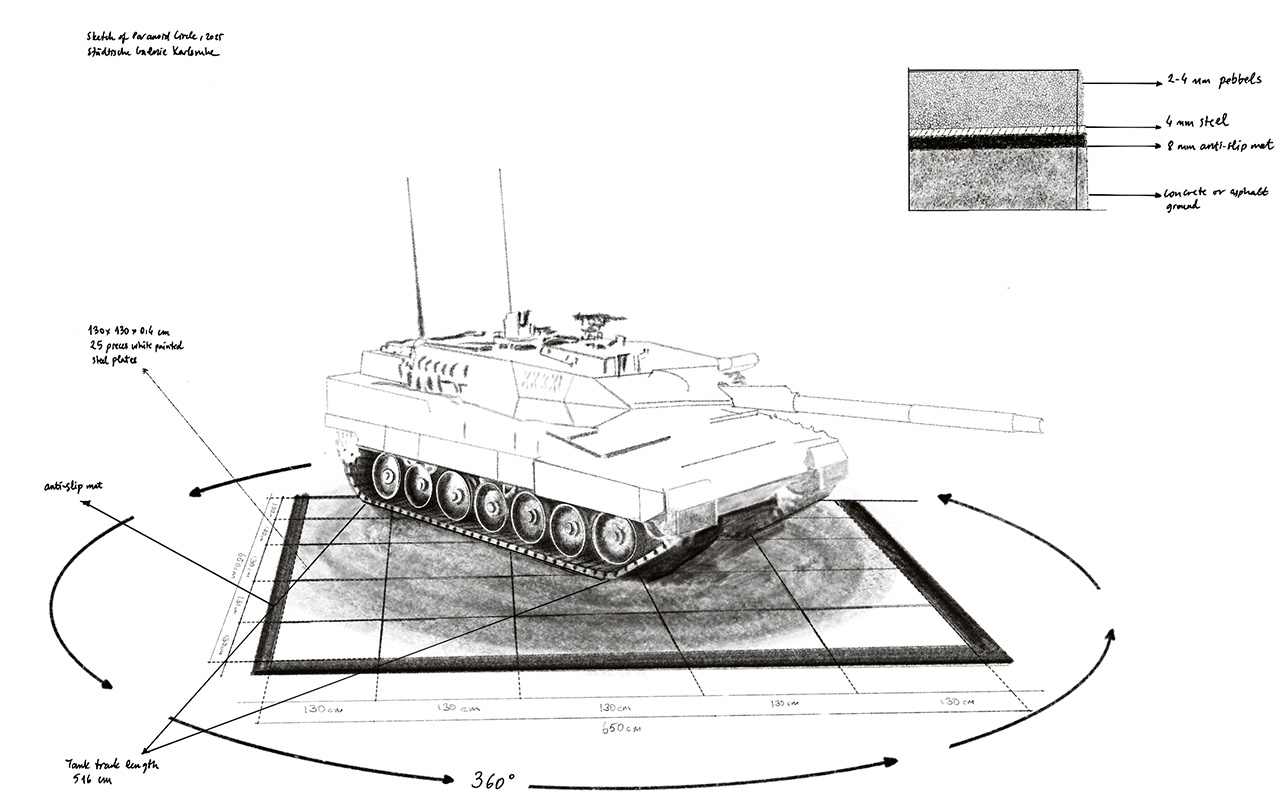
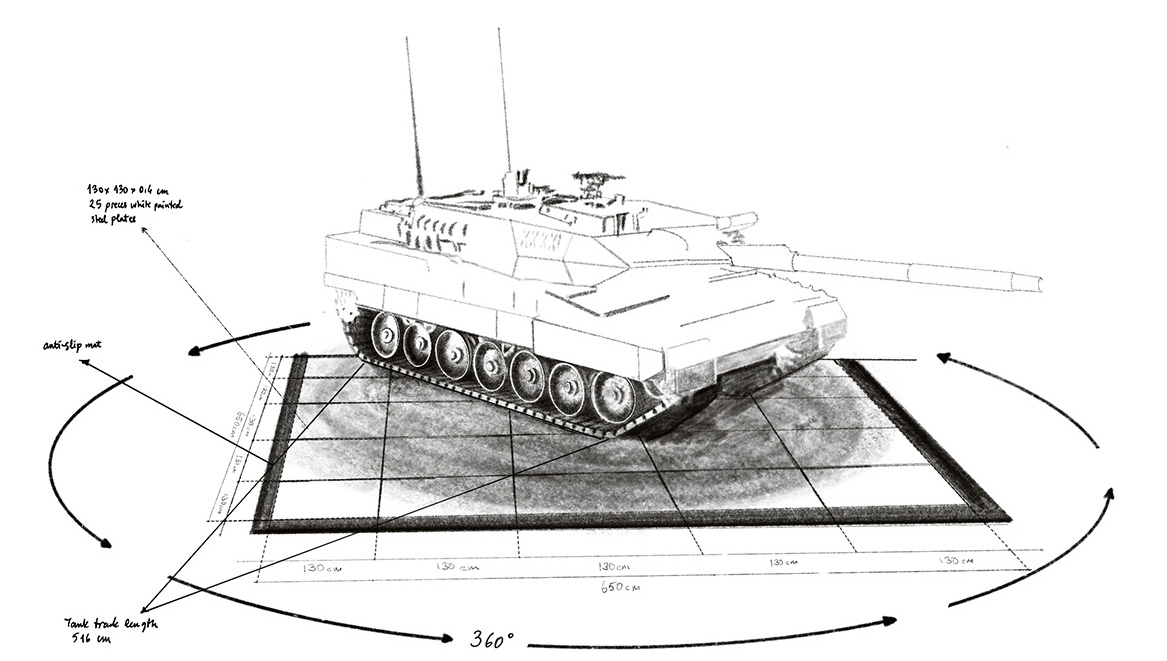
Paranoid Circle consists of a circular pattern created by a tank rotating repeatedly around its own axis on 4 mm thick painted steel plate. Rather than engaging with the tank’s destructive power—or the aesthetics of violence—the project explores how a 60-ton heavy weapon can be transformed into a material for art. In this sense, the work resists weaponization; instead, it reverses it.
The circle, as a form, has been reinterpreted by many artists within various conceptual frameworks over time. It is often associated with ideas such as symmetry, infinity, timelessness, emptiness and so on. However, this circle does not represent any of these concepts; instead, it produces a sense of deadlock.
Here, the tank becomes an “art machine” capable of drawing. It leaks into the artistic expression; much like a brush leaves marks on a canvas, the tank’s tracks inscribes marks onto the steel surface. Through this process, it is instrumentalized and incorporated into an aesthetic mode of production. Considering the material thickness and the dimensions of the work (650 × 650 cm), the piece is conceived to resemble an enlarged drawing on 160 gsm paper.
As the tank moves, it scratches the surface beneath it, gradually forming a circular pattern that simultaneously creates the drawing and conceptually confines the machine within it.
A tank’s ability to rotate 360° relates to its dominance over its surroundings—it can face and move in any direction at will. Yet during the process, its continuous spinning produces another effect: as if it is trying to look in every direction at once. This repetitive motion gives the tank a distinctly paranoid presence.