Ghost Wall (2026)
Performative installation
Bricks, each measuring 24 × 11.5 × 11.3 cm
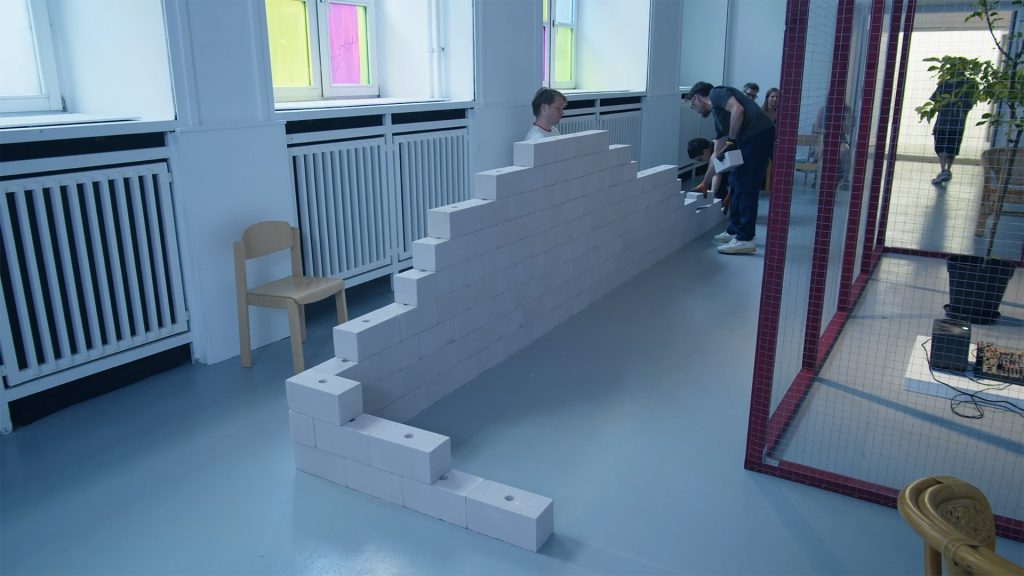
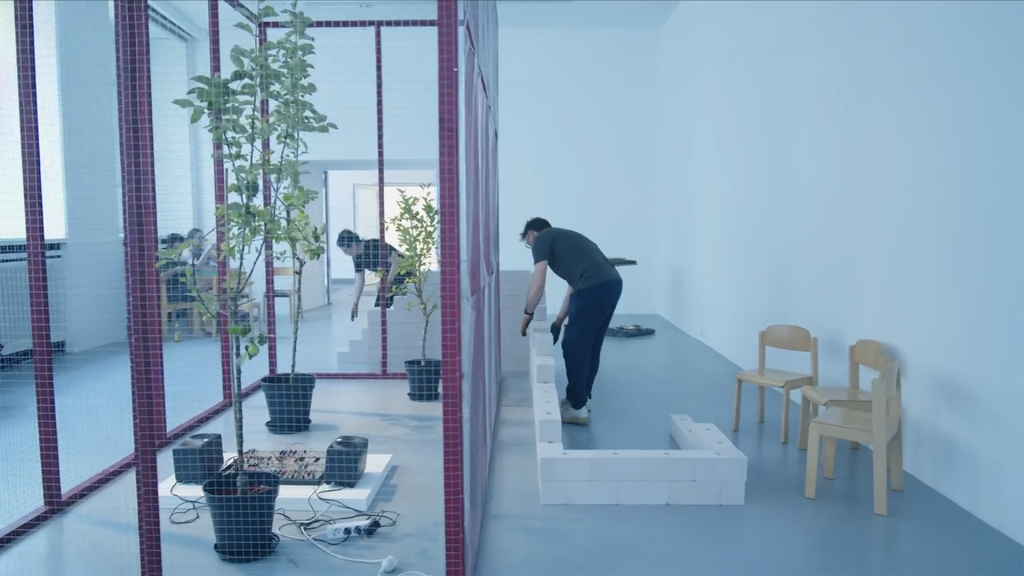
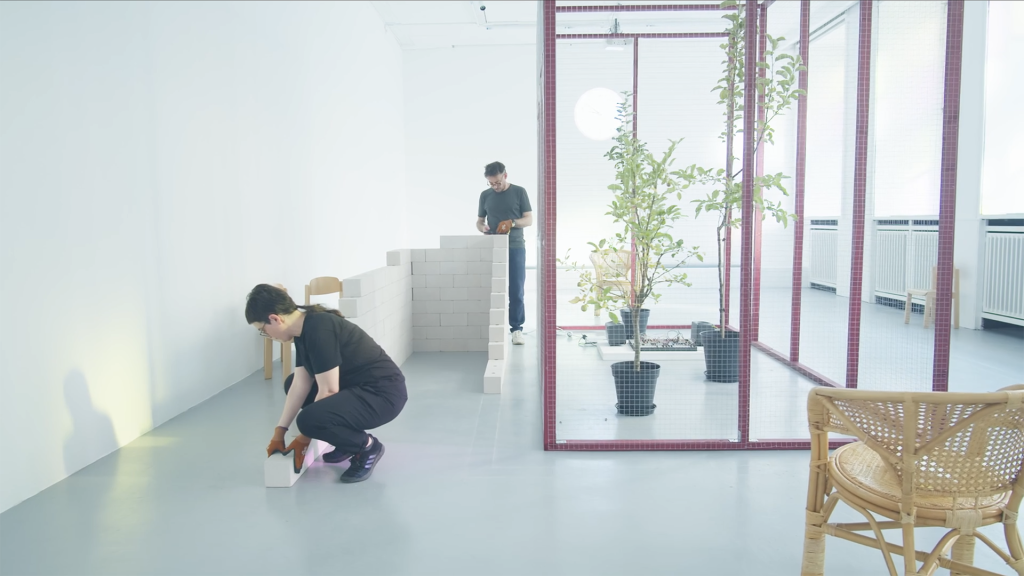
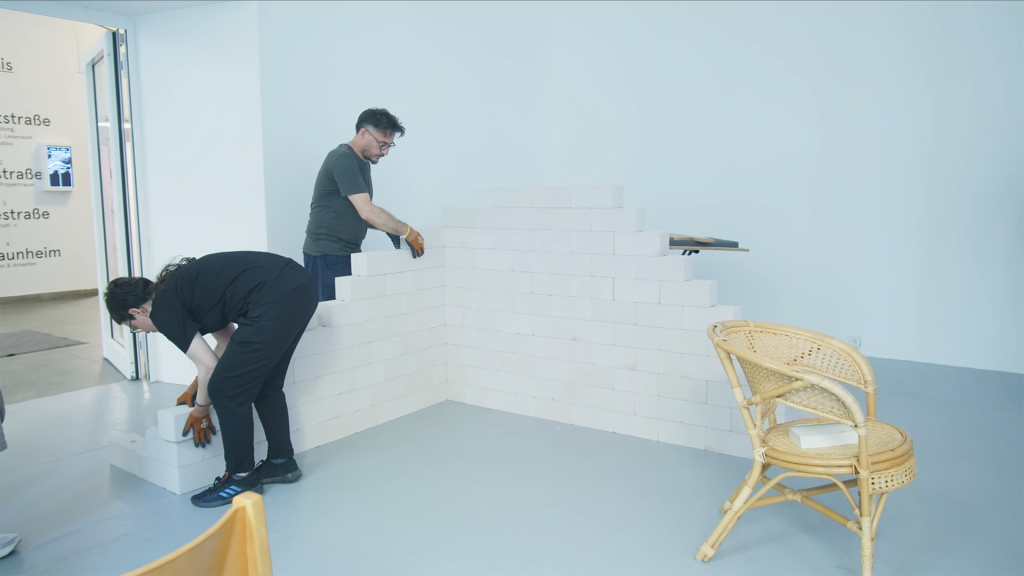
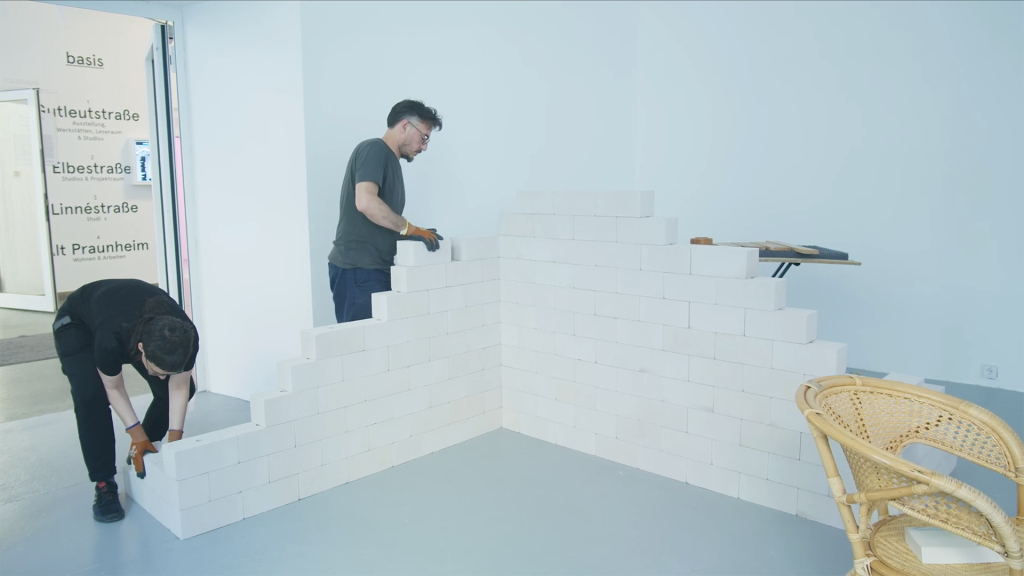
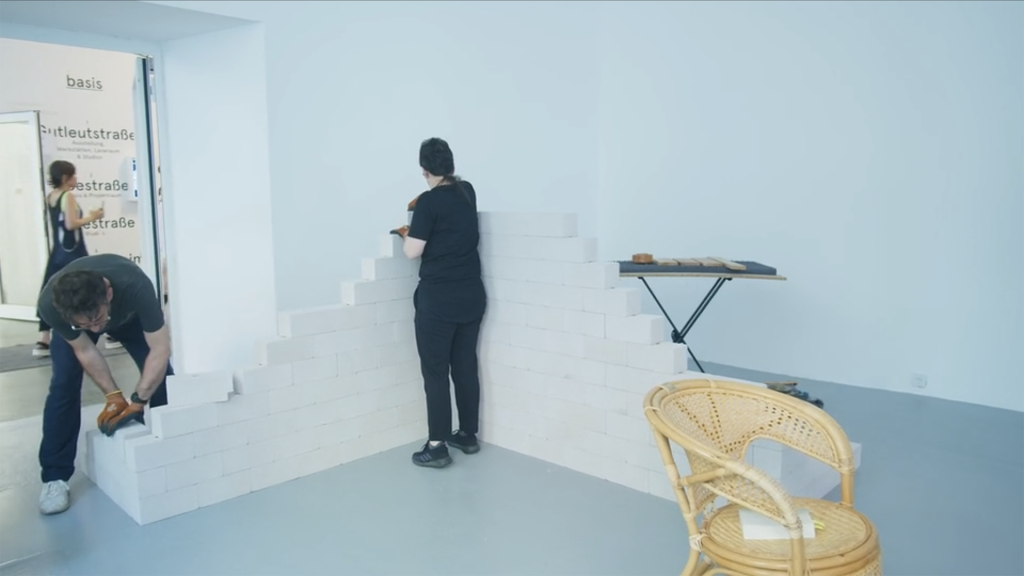
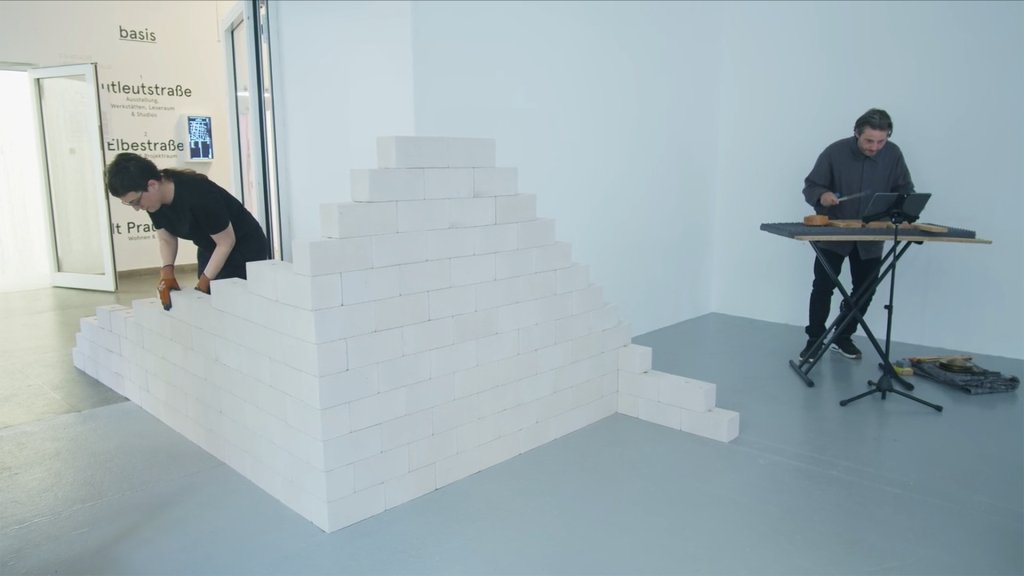
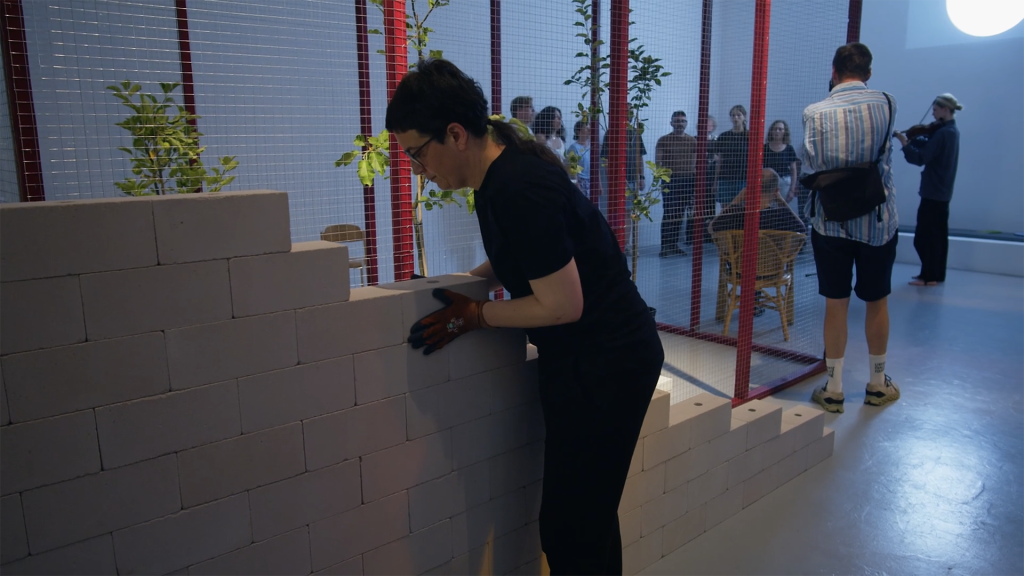
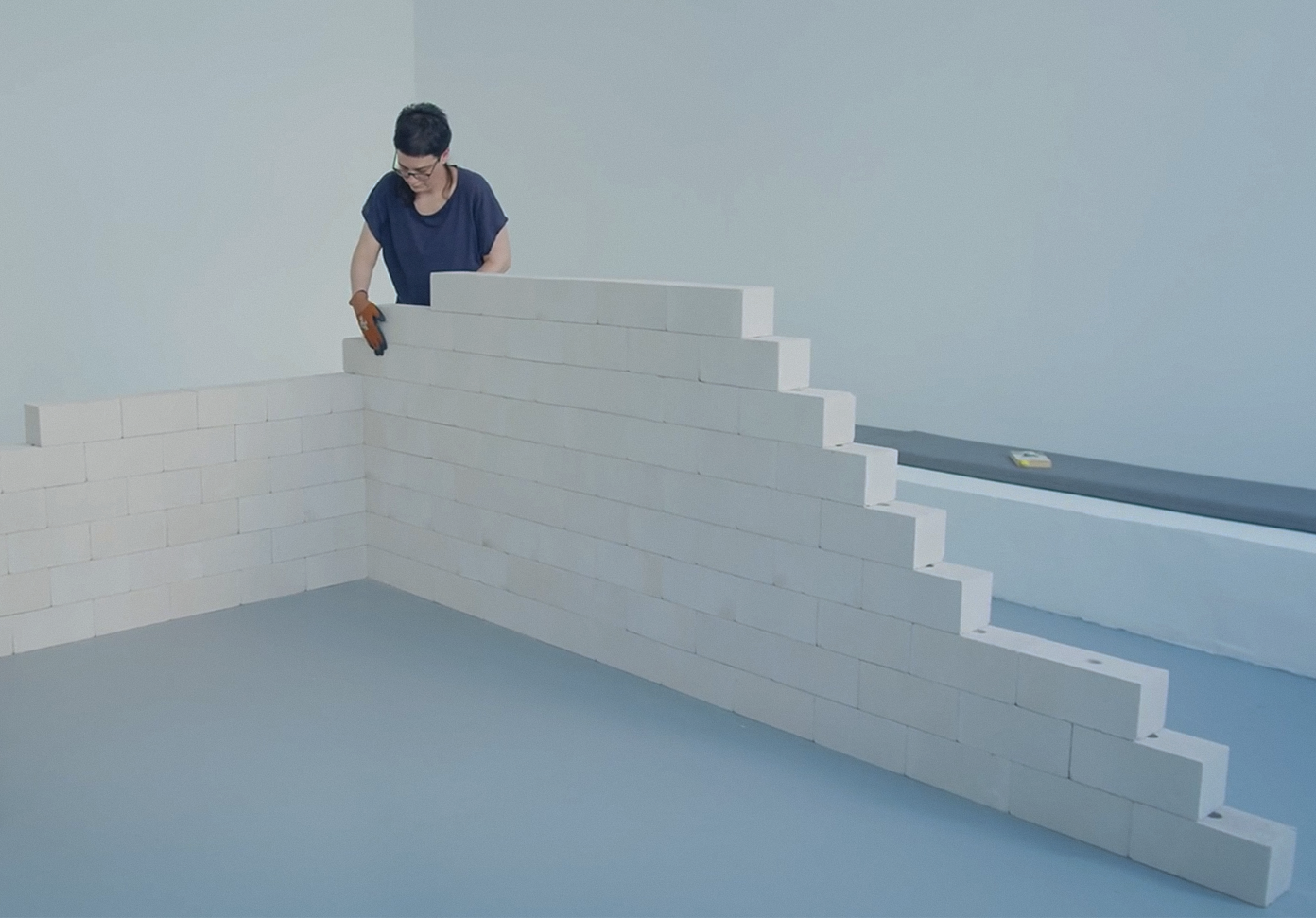
Ghost Wall is a wall made of dozens of bricks that moves continuously through space. Its movement depends on a collective act of reconstruction: the artists move the bricks one by one in the direction of travel, allowing the wall to advance while constantly dismantling and rebuilding itself. As the wall encounters architectural features and physical obstacles, its shape changes. Although it follows a simple looping system, this creates an ever-changing, irregular top edge.
Walls usually define boundaries between the inside and the outside, creating physical and symbolic divisions. They can include or exclude, providing protection or creating isolation. They also guide and control movement through space. However, Ghost Wall has no fixed position and claims no permanent territory. It has no beginning and no end. It neither separates nor unites. It creates neither an inside nor an outside.
Since it serves no practical function, could this wall be something that exists in our minds, beyond its physical presence?
Ghost Wall produces temporary spatial situations that emerge and vanish through movement, centring the worker’s labour. In this way, the work treats the wall not as a fixed object, but as an ongoing process in constant negotiation with the human body, space, and time.
Installation view; Hannes Seidl: Commune – A Happening, Basis e.V., Frankfurt am Main
video stills: Documentation of the premiere, June 19th – 21st 2026, basis Frankfurt e.V. / Film maker: Johannes Schropp
Hannes Seidl: Commune – A Happening
How do we want to live together? The Commune happening explores this question. For five hours a day, musicians, and artists will fill the exhibition spaces of basis e. V. with music, performances, and collaborative readings. Roland Barthes’ ideal of an idiorhythmic community comes to life for three days: a community in which everyone lives according to their own rhythm, makes music independently of one another, yet remains mindful of others. Gatherings in the form of dialogues, trios, or choirs come into being at irregular intervals and dissolve again in favour of a simultaneity of the communal. Three musicians from the Danish ensemble Scenatet perform in the six rooms designed by Anna Berit Asp Christensen, while the Academic Workers’ Song Choir sings a hymn celebrating the pulse of the Commune. This pulse is based on decimal time, a system introduced during the French Revolution that is central to the structure of the Commune. Three clocks displaying decimal time are projected onto the walls of the exhibition, helping participants orient themselves.
Every half hour of decimal time (roughly every 74 minutes of ‘our’ time), the choir sings the canon ‘Il est temps’ (It is time), celebrating both the rhythm of this revolutionary era and an impending revolution. The text is a variation on the lyrics of ‘La Marseillaise’ as it was sung during the Paris Commune.
The scenographic approach for Commune is rooted in the idiorrhythmic monasticism — a practice in which each individual lives according to their own rhythm within a loose communal framework. Idiorhythmia contains a tension between solitude and community: a simultaneity of individual practices that together form a shared field. This understanding of parallel tempi gave rise to the idea of six rooms: each a small world with its own format and materiality, each offering a sensory encounter in its own way. The rooms are conceived as zones for both private and collective immersion; some invite quiet contemplation and exploration, others encourage attentive exchange or improvisational togetherness. Materials, sound and movement are calibrated so that the audience does not merely observe a scenic landscape but becomes co‑creators within it: a simultaneity of individual rhythms and a shared pulse.
In addition, six guests have been invited to enrich the performance with their own contributions. At 8:00 and 9:00 in decimal time (approximately 7:15 p.m. and 9:30 p.m.), Frankfurt-based artists will perform their own works. From a nearly silent performance to electronic improvisations and a DJ set, Commune opens up to the rich local scene.
Schedule:
Friday, 19 June
6:00 p.m. – 11:00 p.m.: Özlem Günyol & Mustafa Kunt: Ghost Wall, performative installation
7:12 p.m.: Julia Mihály: Layers Now Then, electronic music
9:36 p.m.: Marc Behrens: Mitochondrial Pull, electronic music / performance
Saturday, 20 June
6:00 p.m. – 11:00 p.m.: Özlem Günyol & Mustafa Kunt: Ghost Wall, performative installation
7:12 p.m.: Hyunju Oh: Ein Hauch, performance
10:12: Anna Hjalmarsson: DJ set
Sunday, 21 June
6:00 p.m. – 11:00 p.m.: Özlem Günyol & Mustafa Kunt: Ghost Wall, performative installation
7:12 p.m.: Raphaël Languillat: ⌇≈⌇, electronic music
Künstlerische Leitung/ Artistic Direction: Hannes Seidl
Szenographie/ Scenography: Anna Berit Asp Christensen
Mit/With: Scenatet (Katrine Grarup Elbo, Matias Seibæk, Vicky Wright), dem Akademischen Arbeiter*innenlieder- chor.
Gäste/Guests: Marc Behrens, Anna Hjalmarsson, Raphaël Languillat, Julia Mihály, Hyunju Oh, Özlem Günyol & Mustafa Kunt
Auswahl der Texte für die gemeinsamen Lesungen/Selection of texts for the collective readings: Christian Grüny
Künstlerische Mitarbeit/Artistic Collaboration: Sven Rausch
Öffentlichkeitsarbeit/ Public Relations: Olga Appel
Produktionsleitung/ Production Management: ehrliche arbeit – freies Kulturbüro
Commune is a co-production of Hannes Seidl & Briefkastenfirma and Scenatet, funded by Musikfonds, the City of Frankfurt am Main, and Art Music Denmark.